Jev vs Laya: Two Different Visions for AI Decision Models - AppHall
Jev vs Laya: Two Different Visions for AI Decision Models
Jev and Laya represent two different approaches to AI decision models. Jev focuses on managed, high-performance decision APIs, while Laya emphasizes open weights, local deployment, privacy, and fine-tuning. This comparison explores their architectures, strengths, limitations, benchmarks, and what they reveal about the future of specialized AI systems.
Large language models are exceptionally good at generating text, reasoning through complex problems, and interacting with users. But many real-world software systems do not actually need generated language.
They need decisions.
A support system may need to choose between billing, sales, and technical support. A moderation service may need to estimate whether content is safe. An AI agent may need to decide which tool to call. A fraud system may need to determine whether a transaction looks suspicious.
These are not primarily generation problems. They are classification, scoring, routing, and risk-estimation problems.
That is the idea behind a new category of specialized AI systems often described as decision models or System One models.
Two of the most discussed projects in this space are Jev and Laya. They share a similar goal but take very different approaches. Jev is designed as a managed decision API, while Laya is built around open weights, local execution, and customization.
Understanding the difference reveals something larger than a simple model comparison. It shows how AI infrastructure may evolve beyond the idea that one large language model should do everything.
From Text Generation to Typed Decisions
Consider a customer message:
“My application crashes every time I open it.”
A general-purpose LLM might respond:
“This appears to be a technical issue, so the request should be routed to the technical support team.”
For a human reader, that answer is perfectly reasonable.
For software, however, most of the sentence is unnecessary.
System One: fast classification, routing, scoring, and judgment.
System Two: expensive reasoning, planning, or deep analysis.
A well-designed application can use both.
For example, imagine an AI agent deciding whether an action is safe.
A decision model could first estimate:
safe: 0.98 unsafe: 0.02
If confidence is sufficiently high, the system may proceed automatically.
If the result is uncertain:
safe: 0.54 unsafe: 0.46
the request could be escalated to a reasoning model or a human reviewer.
This architecture is attractive because expensive models do not need to handle every decision.
Jev and Laya both target this fast-decision layer.
Jev: Decision Models as a Managed Service
Jev takes a cloud-first approach.
Instead of downloading and operating the model yourself, developers call a hosted API and receive structured probabilistic outputs.
This makes Jev similar to other managed AI services: infrastructure, model serving, optimization, and upgrades are handled by the provider.
Its appeal is straightforward.
Developers do not need to manage:
GPUs,
CUDA environments,
model checkpoints,
quantization,
serving infrastructure,
deployment pipelines.
Jev also supports relatively large contexts and large sets of possible choices, making it suitable for applications where the state or decision schema can become complex.
For a team that simply wants to integrate decision intelligence into an application, this is a compelling proposition.
The trade-off is control.
The model is closed, developers do not receive the weights, and customization is limited compared with an open-weight system.
Laya: The Open-Weight Alternative
Laya approaches the same problem from the opposite direction.
Its models are publicly available under a permissive license, allowing developers to download, self-host, modify, and fine-tune them.
The flagship Laya models are comparatively small by modern AI standards, with versions around the hundreds-of-millions-of-parameters range rather than tens or hundreds of billions.
That changes where the model can run.
Laya can potentially operate on:
private servers,
consumer hardware,
edge devices,
offline environments,
even web browsers.
One experiment demonstrated a quantized Laya model running directly inside a browser through ONNX Runtime Web.
That is a very different deployment model from calling a remote API.
Once the model is downloaded, inference can happen entirely on the user’s device.
For privacy-sensitive applications, this difference is substantial.
Hosted API vs Open Weights
The easiest way to understand Jev and Laya is not as two versions of the same product, but as two different philosophies.
Jev asks:
How can decision models become an easy, reliable cloud service?
Laya asks:
How can developers own, specialize, and deploy decision models themselves?
The difference resembles the broader split between proprietary AI APIs and open-weight model ecosystems.
Jev emphasizes convenience.
Laya emphasizes control.
That distinction affects nearly every technical decision.
Zero-Shot Performance vs Specialization
One of the most important differences appears in benchmark results.
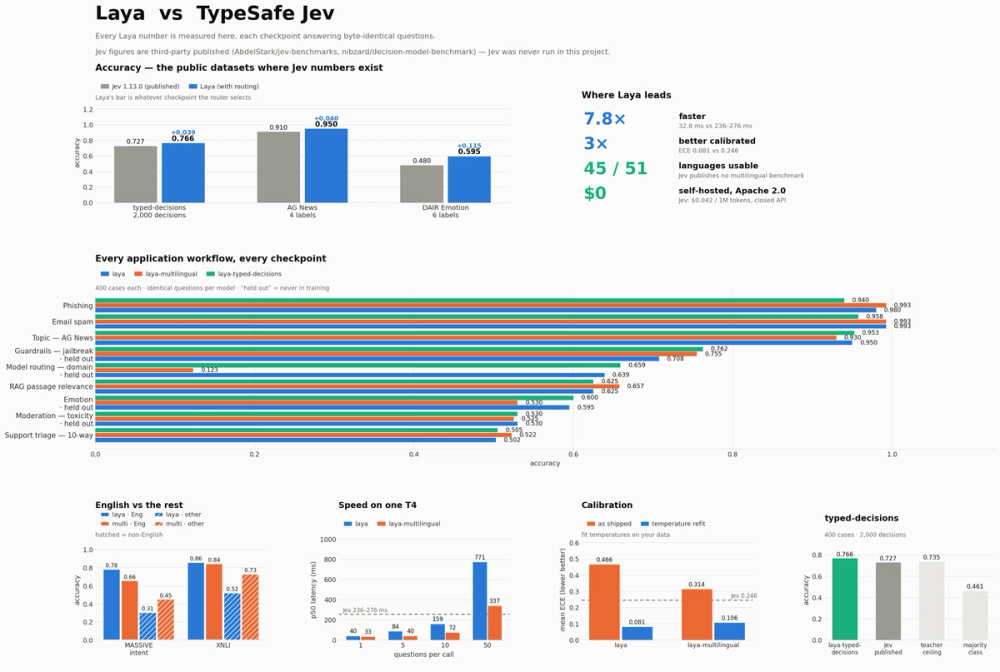
Across several comparisons, Jev often performs better when models are evaluated directly without task-specific training.
This suggests that Jev is currently optimized for strong out-of-the-box decision quality.
Laya's picture is more complicated.
Some reported benchmarks show very strong Laya performance, but those results often involve specialized or fine-tuned checkpoints.
A base Laya model may perform considerably worse in zero-shot settings than a task-adapted version.
This is not necessarily a weakness in Laya's design.
It reflects its intended role.
Laya is especially interesting as a foundation for specialization.
If a company has proprietary examples of support tickets, fraud cases, moderation decisions, or routing rules, it can fine-tune the model for that exact environment.
Jev largely removes that responsibility.
Laya exposes it.
Choice Space Matters
Another important difference is the number of possible answers.
A decision with three options is easy to imagine:
billing sales technical
But real systems can contain dozens or hundreds of categories.
Large intent-classification benchmarks, for example, may contain more than 70 possible labels.
Current comparisons suggest that Jev handles large choice spaces better than Laya's existing checkpoints.
This could matter significantly for applications such as:
large tool-selection systems,
enterprise ticket routing,
broad taxonomies,
multi-class intent detection.
Laya is more comfortable today when the option set is relatively constrained.
That may improve as architectures and checkpoints evolve, but it remains an important practical distinction.
Context Length Is Another Major Difference
Jev also has an advantage when decisions depend on large amounts of context.
Hosted versions support substantially longer input contexts than current Laya checkpoints.
This means Jev is better suited to questions involving:
long conversations,
large documents,
extensive agent histories,
complex application state.
Laya's shorter contexts are more appropriate for compact decision tasks such as:
short support messages,
moderation snippets,
safety checks,
simple routing,
local classification.
For many real-time applications, that is enough.
For document-scale decisions, it may not be.
Local Latency vs API Latency
Performance comparisons between the two can also be misleading.
Laya can produce extremely low latency when running locally on warm hardware.
Jev must travel through a network request before returning a response.
Therefore, a benchmark such as:
Laya local: tens of milliseconds Jev API: more than one hundred milliseconds
does not necessarily prove that Laya's underlying model is inherently several times faster.
The Jev number includes network overhead.
At the same time, Jev may gain an advantage when many questions are evaluated together.
Some tests indicate that Laya's execution time increases more directly as the number of questions grows, while Jev can efficiently process multiple decisions through its hosted architecture.
The better option therefore depends on workload shape.
For a single local decision, Laya can be extremely responsive.
For batched or multi-question workloads, Jev may be more competitive.
Why Fine-Tuning Could Be Laya's Biggest Advantage
Open weights become particularly valuable when the meaning of a decision is specific to one organization.
Consider the word “urgent.”
A generic model may understand urgency linguistically.
But a company may define urgency using internal business rules:
customer value,
service-level agreement,
outage severity,
business hours,
contract terms.
In that environment, a specialized model can learn what “urgent” means for that company.
This is where Laya becomes especially interesting.
Developers can train it on their own examples and produce a private decision model aligned with their domain.
The result may be more useful than a generic model, even if the generic model initially performs better zero-shot.
Privacy and Offline Deployment
For some organizations, benchmark accuracy is not even the first consideration.
Data governance is.
Healthcare providers, banks, government systems, and enterprises may have data that cannot be sent to third-party services.
A hosted API may therefore be unacceptable regardless of cost or convenience.
Laya can operate entirely within private infrastructure.
That makes possible:
offline inference,
air-gapped deployments,
on-premise processing,
browser-side execution,
private fine-tuning.
This is one of the clearest areas where the two projects serve different markets.
Jev sells managed intelligence.
Laya offers deployable infrastructure.
“No Hallucinations” Does Not Mean “No Mistakes”
Decision models are sometimes described as eliminating hallucinations.
That phrase needs clarification.
A constrained decision model does solve one major problem associated with generative systems: malformed or unexpected outputs.
If the allowed answers are:
billing sales technical
the system will not invent:
billing_department_v2
or return a long essay instead of a category.
But the model can still choose the wrong answer.
A probability distribution is structured, not infallible.
This is why confidence thresholds remain important.
A robust production system might use rules such as:
Decision models should therefore be treated as probabilistic components inside a larger control system.
The More Important Trend
The most interesting part of Jev vs Laya is not which model wins a particular benchmark.
It is what both projects suggest about the future of AI architecture.
For the last few years, developers have often used general-purpose LLMs for almost every AI task.
The emerging stack may be more specialized:
generation → language model reasoning → reasoning model retrieval → embedding model ranking → reranker vision → vision model decision → decision model
AI agents may increasingly combine these systems instead of routing every problem through one massive model.
Fast decision models can handle repetitive judgments.
Reasoning models can be reserved for ambiguous or complex cases.
That can reduce latency, cost, and unnecessary generation.
Jev or Laya?
The answer depends less on which project is universally “better” and more on what the application requires.
Jev is attractive when you want:
strong out-of-the-box performance,
minimal infrastructure,
long contexts,
large choice spaces,
a managed API,
rapid integration.
Laya is attractive when you need:
self-hosting,
open weights,
offline operation,
private inference,
fine-tuning,
browser or edge deployment,
full control over the model.
In simple terms:
Jev is a cloud-native decision engine.
Laya is an open foundation for building your own decision engine.
Both are interesting because they challenge a common assumption in modern AI development: that every intelligent task should be solved by generating text.
For many applications, the future may look very different.