Mercury 2.5: A Diffusion LLM Built for the Agent Era - AppHall
Mercury 2.5: A Diffusion LLM Built for the Agent Era
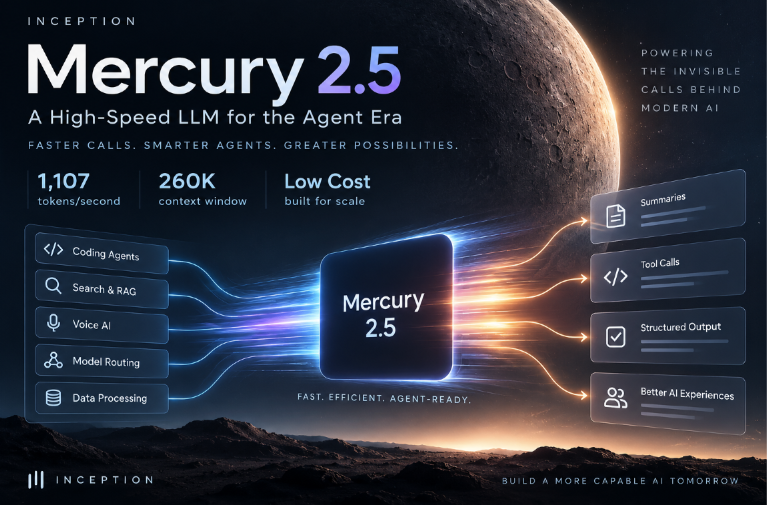
Mercury 2.5 is a high-speed diffusion language model from Inception, built for AI agents, coding assistants, search, voice, and multi-model workflows. With over 1,100 tokens per second, a 260K context window, and low-cost inference, it targets the invisible model calls that power modern AI systems.
Large language models are usually judged by one question: how intelligent is the model?
Mercury 2.5 takes a different approach.
Developed by Inception, Mercury 2.5 is a production-focused diffusion language model designed around speed, low cost, long context, and high-frequency model usage. Instead of competing only for the title of “smartest model,” it targets a growing problem in modern AI systems: the dozens of model calls that happen behind the scenes before a user ever sees the final answer.
That makes Mercury 2.5 especially relevant for AI agents, coding assistants, search systems, voice applications, retrieval pipelines, and multi-model architectures.
Its headline number is impressive: Inception reports generation speeds of more than 1,100 tokens per second under its benchmark conditions. But raw speed is only part of the story.
The more important question is what becomes possible when model calls are fast and inexpensive enough to be used repeatedly inside a single workflow.
A Different Kind of Language Model
Most mainstream LLMs are autoregressive.
They generate text sequentially:
Token 1 → Token 2 → Token 3 → Token 4
Each token depends on the tokens generated before it.
Mercury is based on a different idea. As a diffusion language model, it can work on multiple token positions in parallel and iteratively refine the output until it converges on a final response.
Conceptually, the process looks more like:
Incomplete token state
        ↓
Parallel refinement
        ↓
Further refinement
        ↓
Final text
This architecture is one reason Mercury can achieve very high throughput compared with traditional autoregressive generation.
Mercury 2.5 is Inception’s latest major step in this direction. The company describes it as its most capable Mercury model to date and says it significantly improves intelligence over Mercury 2 while retaining the speed advantage of diffusion-based generation.
More Than 1,100 Tokens per Second
The most eye-catching specification is its reported output speed of around 1,107 tokens per second.
For a normal chatbot, that may sound excessive. Most users do not need thousands of words to appear instantly.
For an agent system, however, the value is much clearer.
Modern AI applications often involve many internal model calls. A single user request may trigger tasks such as:
intent classification
query rewriting
tool selection
retrieval
reranking
context compression
structured extraction
safety checks
response formatting
model routing
BenchLM describes these as the “calls you don’t see.”
A user may only experience one final answer, while the system behind it has already invoked language models ten, twenty, or even more times.
That changes how latency should be measured.
If every internal model call takes one or two seconds, the delays accumulate quickly. If those auxiliary calls can be completed in a fraction of that time, the entire application becomes more responsive.
Mercury 2.5 is built for exactly this type of workload.
Why Agents Need Fast Models
The rise of AI agents has changed what developers need from language models.
A traditional chatbot may make one main inference call per user message.
An agent might perform something closer to this:
User Request
    ↓
Plan
    ↓
Choose Tool
    ↓
Rewrite Query
    ↓
Search
    ↓
Evaluate Results
    ↓
Compress Context
    ↓
Call Main Reasoning Model
    ↓
Extract Final Answer
Many of these tasks do not require the most expensive frontier model available.
For example, choosing a tool, summarizing a long context window, extracting structured fields, or deciding which model should handle a request may need reliability and speed more than maximum reasoning depth.
This is where Mercury 2.5 becomes interesting.
Instead of replacing every advanced reasoning model, it can operate as a fast infrastructure layer around them.
A system might use Mercury for routing, compression, retrieval assistance, and structured processing while reserving a larger frontier model for the hardest reasoning step.
That architecture could reduce both latency and cost.
A 260K Context Window
Mercury 2.5 also expands its context window to roughly 260,000 tokens, a substantial increase over the previous generation.
This matters because many agent workloads involve extremely long histories.
A coding assistant, for example, may accumulate:
source files
previous edits
terminal output
tool results
conversation history
documentation
repository metadata
Eventually, all of that context becomes too expensive or inefficient to pass repeatedly into a larger model.
One solution is context compaction.
A fast model can read a very large history and compress it into a shorter representation before handing it to the main reasoning model.
Conceptually:
200K tokens of history
        ↓
Mercury 2.5
        ↓
Compact working context
        ↓
Primary coding model
This is one of the clearest examples of why a fast, long-context model can be valuable even if it is not the final model answering the user.
Coding Agents as a Natural Use Case
Inception highlights coding agents as one of Mercury 2.5’s major applications.
The company has discussed its use in workflows such as:
context compaction
model routing
MCP tool search
These tasks are deeply embedded in modern coding assistants.
In one customer example involving Augment Code, Inception reports that moving context compaction to Mercury significantly reduced latency and cost.
The important lesson is not the exact benchmark number.
It is the architectural pattern.
Mercury does not necessarily need to write the final application or solve the hardest programming problem. Instead, it can handle the many repetitive infrastructure tasks surrounding the primary coding model.
That division of labor may become increasingly common as AI systems grow more complex.
Search and RAG Workflows
Search is another area where Mercury’s design makes sense.
Modern AI search systems are rarely a simple pipeline of:
A single search request can therefore fan out into many language-model operations.
Speed matters at every stage.
Low-cost inference matters too, because search products may process these workflows at very high volume.
A model such as Mercury 2.5 can potentially handle the fast intermediate steps while another model performs the final synthesis.
This makes diffusion LLMs particularly interesting for retrieval-augmented generation and agentic search architectures.
Voice AI and Latency
Voice systems may be an even stronger fit.
People are highly sensitive to delays in conversation. A pause that feels acceptable in text can feel awkward during a spoken interaction.
For a voice agent, hundreds of milliseconds can materially change the experience.
Inception has highlighted Mercury deployments where model response latency was reduced to well below one second, and it has also introduced Mercury Voice for low-latency conversational applications.
Again, the broader point is that language-model speed becomes increasingly important as AI moves from asynchronous text generation into real-time interaction.
Fast inference is not simply a convenience.
It can affect whether the interface feels natural.
Mercury Router and Multi-Model Systems
Another notable product in the Mercury ecosystem is Mercury Router.
Its purpose is to select which model should handle a given request.
That could mean routing prompts between different commercial or open models based on factors such as:
task difficulty
latency requirements
cost
model capability
response format
Model routing itself introduces overhead, so the router must be fast enough that it does not erase the benefits of choosing a better downstream model.
A high-speed model is therefore well suited to this role.
This points toward a future in which AI products are less dependent on one universal model and instead use a network of specialized models.
Mercury could become one of the models coordinating that network.
Aggressive Pricing
Mercury 2.5 is also positioned aggressively on price.
Inception lists standard API pricing at roughly:
$0.20 per million input tokens
$0.75 per million output tokens
Launch promotions have reduced those rates further.
Third-party providers may charge different amounts, but the overall pricing strategy reinforces Mercury’s intended use case.
The model is designed to be called often.
That matters because the economics of agent systems are different from those of simple chatbots.
If one user request triggers 20 internal inference calls, even small differences in per-token pricing can become significant at scale.
Mercury’s value proposition is therefore not just “cheap text generation.”
It is enabling architectures where frequent model usage is economically practical.
OpenAI-Compatible Access
Platforms such as Venice provide Mercury 2.5 through APIs that are compatible with the OpenAI API format.
For developers, that can lower migration friction.
Existing applications may only need to change the model identifier, API endpoint, and credentials rather than redesign the entire integration.
Venice also adds its own privacy and infrastructure features around the model.
Those platform-level features should be distinguished from the underlying Mercury model itself, but they show how quickly diffusion LLMs are being integrated into the broader AI tooling ecosystem.
Current Limitations
Mercury 2.5 is promising, but it also has important limitations.
First, it is not an open-weight model, so developers cannot simply download the weights and run it independently.
Second, it is primarily a text model rather than a general multimodal system.
Third, many of the strongest performance claims currently come from Inception itself or from material based on the company’s benchmarks and customer examples.
Independent benchmarking is still less extensive than it is for major models from companies such as OpenAI, Anthropic, or Google.
The reported 1,100-plus tokens-per-second figure should therefore be understood as a vendor benchmark rather than a universal real-world speed guarantee.
Actual application latency will depend on factors such as prompt size, network conditions, server load, API provider, and time to first token.
Why Mercury 2.5 Matters
The most interesting thing about Mercury 2.5 is not that it generates text extremely quickly.
It is what that speed suggests about the future architecture of AI applications.
For years, the industry focused heavily on one question:
How powerful can a single model call become?
Agent systems introduce another question:
How cheap and fast can dozens of model calls become?
That may lead to a different kind of AI stack.
Instead of sending every task to one enormous model, future systems may combine:
Fast model for routing
Fast model for retrieval
Fast model for compression
Fast model for extraction
Powerful model for deep reasoning
Fast model for final processing
In that architecture, the models surrounding the main reasoning engine become just as important as the reasoning engine itself.
Mercury 2.5 is built for that layer.
It is best understood not simply as another chatbot model, but as a high-speed language-model infrastructure component for the agent era.
Whether diffusion language models become a dominant architecture is still an open question. But Mercury 2.5 demonstrates why the approach is attracting attention: once language-model inference becomes sufficiently fast and inexpensive, developers can build systems that use intelligence repeatedly rather than sparingly.
And that could change how AI applications are designed.