If you recently came across Laya LLM, you may be wondering whether Laya is another ChatGPT-style large language model.
The short answer is: not exactly.
Laya is better described as a System 1 decision model rather than a conventional generative LLM. Instead of writing paragraphs, answering open-ended questions, or generating code, Laya is designed to make fast, structured decisions over text.
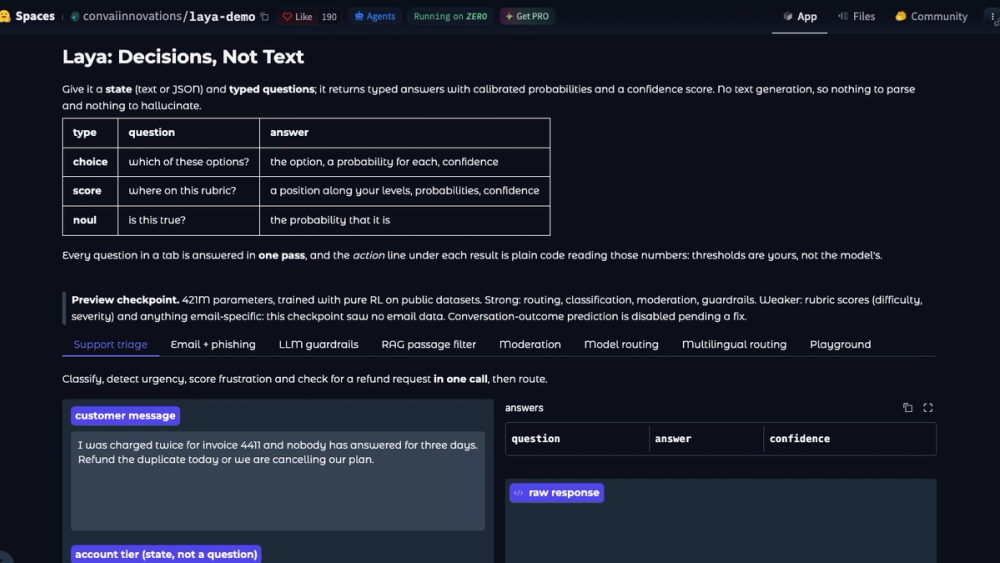
Give it an email, customer ticket, document, or JSON object, define a question with a limited set of possible answers, and Laya can return a choice, score, or probability.
That makes Laya interesting for tasks such as intent classification, support-ticket routing, moderation, risk scoring, workflow automation, and AI agent decision making.
So why are people searching for “Laya LLM,” and where does it fit alongside GPT, Claude, and newer decision models such as Jev?
What Is Laya AI?
Laya is an open-weight, non-autoregressive decision model developed by Convai Innovations.
Its main purpose is simple:
turn unstructured information into structured decisions without generating text first.
A normal LLM workflow might look like this:
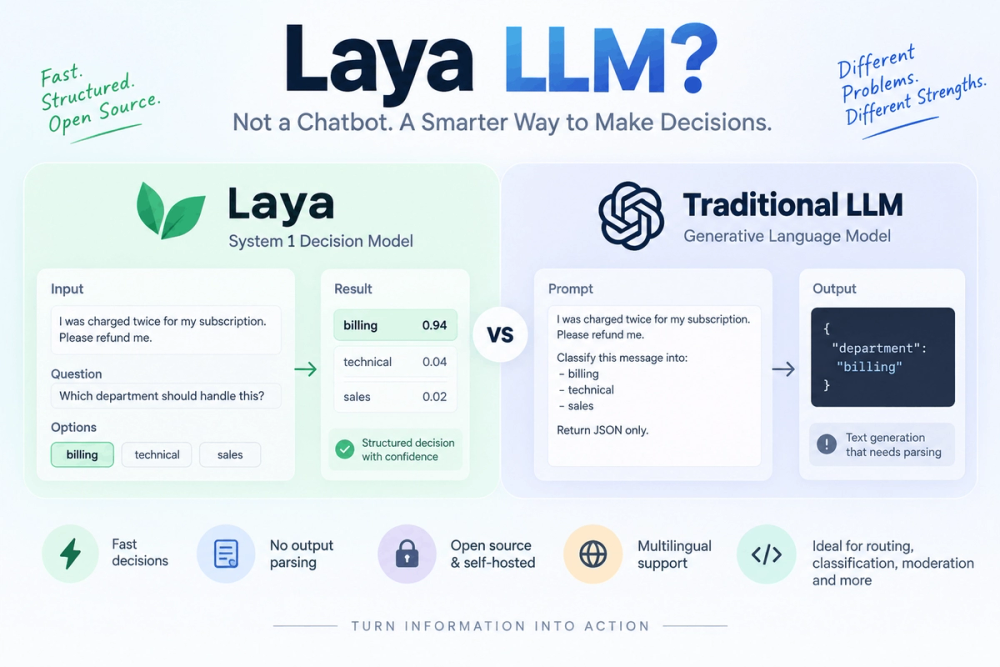
Customer message: "I was charged twice for my subscription." Classify this message into: - billing - technical support - sales Return JSON only.A generative model may then produce:
{ "department": "billing" }This works, but the model is still performing text generation. Developers often need prompts such as “return JSON only,” output parsers, validation rules, retries, and additional error handling.
Laya approaches the same problem differently.
You provide the state, the question, and the allowed answers. The model scores the possible decisions directly.
For example:
State: "I was charged twice for my subscription." Question: Which department should receive this request? Options: - billing - technical - salesThe result can be represented as a structured choice with a confidence score.
There is no paragraph to parse and no need to ask the model to format its answer as JSON.
Is Laya an LLM?
Technically, calling Laya an “LLM” is misleading.
Laya's English model is built around ModernBERT-large, an encoder architecture. Its primary English checkpoint has about 421 million parameters.
Traditional generative LLMs such as GPT-style models are autoregressive: they predict tokens one after another to generate a response.
Laya does not work that way.
It evaluates the input and its possible decisions in a forward pass and produces structured outputs rather than open-ended text. The project describes three main decision types:
- Choice — select one option from a predefined list
- Score — assign a value on a scale
- Noul — return a yes/no-style probability
This makes Laya closer to a specialized decision engine than a chatbot.
People still search for terms such as “Laya LLM” because “LLM” has increasingly become a generic label for downloadable AI models. But if you expect Laya to write articles, summarize documents, or hold a conversation, it is the wrong tool.
Laya vs Traditional LLMs
The difference becomes clearer when you look at what each type of model is trying to accomplish.
| Task | Laya | Generative LLM |
|---|---|---|
| Write an email | No | Yes |
| Generate an article | No | Yes |
| Answer open-ended questions | Limited | Yes |
| Classify support tickets | Yes | Yes |
| Route incoming requests | Yes | Yes |
| Return fixed choices | Yes | Yes |
| Produce probability scores | Designed for it | Possible |
| Generate arbitrary JSON | No | Yes |
| Local structured decision making | Strong use case | Possible |
The key difference is not that LLMs cannot classify things.
They can.
The question is whether a large generative model is necessary when the final result is only one label, number, or probability.
Imagine an application processing thousands of customer messages.
It may only need to decide:
billing technical sales spamUsing a large generative model to produce one of four known answers can be unnecessarily complicated. Laya is designed specifically for this kind of bounded decision.
Why Would Developers Use Laya?
1. Fast structured decisions
Because Laya does not generate text token by token, it can make decisions quickly.
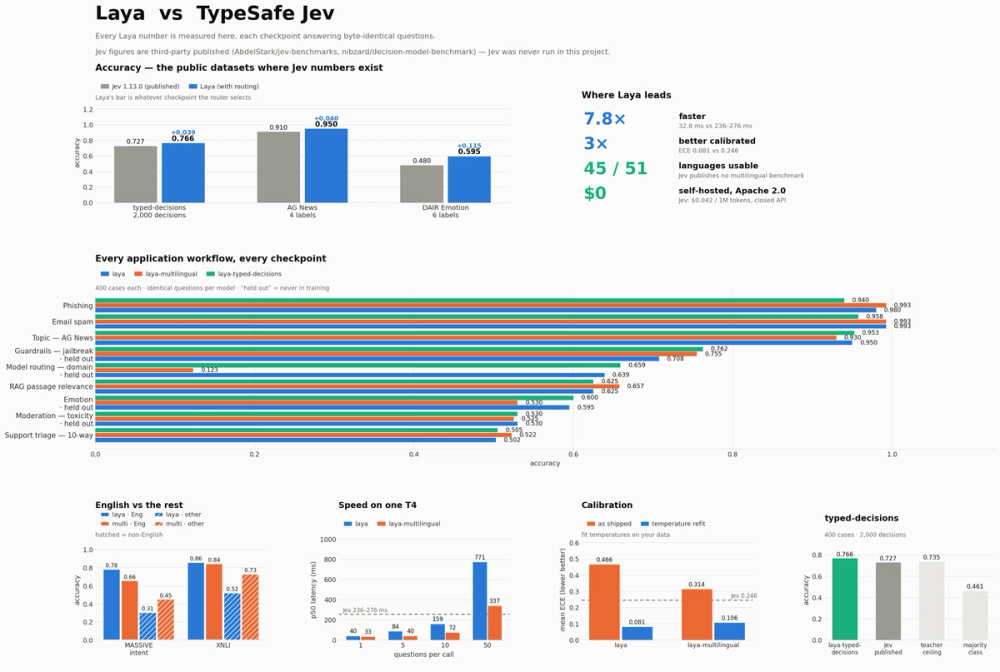
The project's published benchmarks report roughly 33 ms for a single question on a T4 GPU, with lower per-question latency when multiple questions are batched.
Real-world performance will naturally depend on hardware and workload, but the architecture is fundamentally optimized for decision making rather than generation.
2. No output parsing
LLM applications often contain instructions such as:
Return valid JSON. Do not include markdown. Do not explain your answer.Developers then build parsers around the result anyway.
Laya avoids this pattern because its output is structured by design.
3. Local deployment
Laya is released under the Apache 2.0 license and its weights can be downloaded and self-hosted.
That matters for applications where developers do not want every customer email, private document, or internal workflow sent to a third-party model API.
It also gives teams more control over infrastructure and fine-tuning.
4. Smaller model size
The main English Laya checkpoint has about 421M parameters, while the multilingual version is around 322M parameters.
That is tiny compared with modern general-purpose LLMs.
The smaller size makes Laya interesting for local applications, internal services, edge deployments, and high-volume classification systems.
5. Multilingual support
Laya also provides a multilingual checkpoint based on mmBERT, designed for more than 100 languages. The project's router can automatically send requests to different checkpoints depending on the input language and task.
What Can Laya Be Used For?
The most interesting Laya applications are situations where the possible answers are already known.
Customer support routing
Analyze an incoming ticket and choose:
billing refund technical account salesEmail triage
Decide whether a message is:
urgent normal low priority spamModeration
Estimate whether content should be:
allow review blockLead qualification
Score whether a lead appears likely to convert.
AI agents
A generative model can handle reasoning and language while Laya handles frequent operational decisions such as:
Which tool should I call? Should this request be escalated? Which workflow should run next?This creates an interesting architecture where an LLM does not need to make every small decision itself.
Laya vs Jev
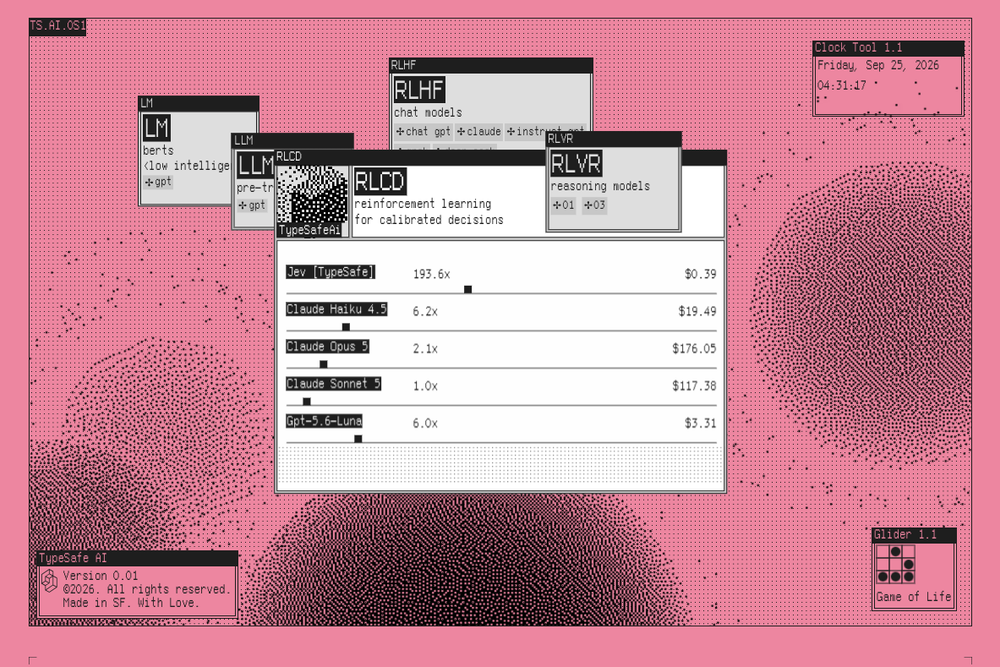
Laya is frequently mentioned alongside Jev, another model designed around the idea of fast System 1 decisions.
The two products target similar workloads: choice, scoring, routing, and probability-based decisions instead of free-form generation.
But their deployment models are different.
Jev is primarily offered as a hosted decision model, while Laya provides open weights that developers can run themselves.
That makes the comparison less about which model is universally better and more about what a developer needs.
Laya may be attractive when:
- self-hosting matters
- open weights matter
- local inference matters
- fine-tuning is required
- data should stay inside your infrastructure
Jev may be attractive when developers prefer a managed API and do not want to operate models themselves.
Benchmark results should also be treated carefully. Independent tests have found substantial differences depending on task complexity, input length, number of choices, and prompt format.
Is Laya Better Than an LLM?
That is probably the wrong question.
Laya and generative LLMs solve different problems.
If you need:
- writing
- coding
- summarization
- conversation
- research
- open-ended reasoning
use a generative LLM.
If your application repeatedly asks:
Which option? How likely? How urgent? Which route? Yes or no?a specialized decision model becomes much more interesting.
In many applications, the best architecture may use both.
An LLM handles language-heavy reasoning, while Laya acts as a lightweight decision layer for frequent structured tasks.
Important Limitations
Laya's structured outputs should not be confused with perfect accuracy.
A model can return valid probabilities and still make the wrong decision.
The project's own benchmark documentation makes an important point: Laya should be treated as a fast base to specialize, not as a universally strong zero-shot decision model. Performance can decline on large option sets, unfamiliar tasks, or inputs outside its training distribution.
This means developers should evaluate Laya on their actual workload before replacing an existing classifier or LLM pipeline.
Fine-tuning and calibration may also be important for production applications.
Why Laya Matters
For the last several years, much of AI application development has followed one pattern:
Send everything to a large generative model.
Laya represents a different idea.
Not every AI task requires generation.
Sometimes software simply needs to turn an input into a reliable structured decision.
That makes Laya part of a broader movement toward smaller, specialized AI models that sit alongside LLMs rather than replacing them.
For developers building routing systems, moderation tools, classifiers, agents, or high-volume automation, that idea is worth watching.
Final Thoughts
If you searched for Laya LLM, the most important thing to understand is that Laya is not trying to be another ChatGPT.
It is a small, open-weight decision model designed to answer bounded questions quickly.
Instead of asking:
“What text should I generate?”
Laya focuses on:
“Which decision should I make?”
That distinction may sound small, but for AI applications processing millions of repetitive decisions, it can lead to a very different—and potentially much simpler—architecture.
Laya is still a young project, and its real-world usefulness will depend heavily on the task. But it highlights an important trend in AI development: the future may not be one giant LLM doing everything.
It may be a collection of specialized models, each doing one job well.