Dessa AI Voice Model: What It Is, How It Works, and How to Try It - AppHall
Dessa AI Voice Model: What It Is, How It Works, and How to Try It
Discover Dessa AI, Block's speech-only voice model designed for natural, full-duplex conversations. Learn how this experimental technology handles interruptions, emotion, and real-time speech. Explore its most important features, official demonstrations, hardware requirements, download availability, and how Dessa compares with existing AI voice assistants.
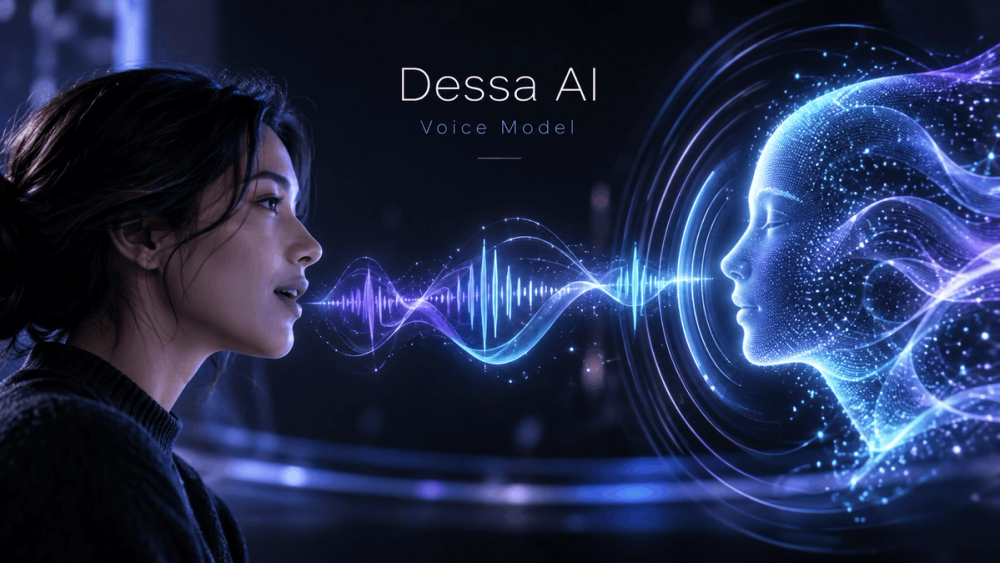
What if an AI could talk to you without first converting your words into text? What if it could laugh naturally, interrupt at the right moment, recognize emotional cues, and respond with the rhythm of a real conversation?
That's the idea behind Dessa AI, a new speech-to-speech artificial intelligence model introduced by Jack Dorsey's company, Block, on October 23, 2026.
Unlike traditional voice assistants, the Dessa AI voice model was reportedly trained entirely on recordings of human conversations, without text-based training data or pretrained language models.
Its early demonstrations have attracted attention for their remarkably natural speech, conversational timing, and emotional expression.
But can you actually use Dessa AI? Is there a Dessa AI download available? And how does it compare with other AI voice technologies?
Here's everything you need to know.
What Is the Dessa AI Voice Model?
Dessa AI is a full-duplex, speech-to-speech AI model developed by Block, the financial technology company behind Square and Cash App.
The model was created by a research team that includes former members of Dessa, a Toronto-based AI startup acquired by Square in 2020.
Block officially introduced the new model in October 2026 as a research preview.
Dessa's central innovation is its audio-native approach to artificial intelligence.
Many conventional voice assistants operate through a pipeline:
Convert incoming speech into text.
Process the text using a language model.
Generate a written response.
Convert that response back into synthesized speech.
Dessa takes a different approach.
According to Block, the model learns directly from human conversations and generates spoken responses without requiring an intermediate text representation.
This design is intended to preserve information that traditional transcription-based systems may lose, including emotion, timing, hesitation, and vocal expression.
Key Features of Dessa Voice AI
1. Speech-Only Training
One of Dessa's most distinctive features is its training methodology.
Block says the model was trained from scratch using human speech recordings, without relying on written text or pretrained language models.
This makes Dessa an interesting experiment in whether artificial intelligence can develop conversational capabilities through spoken language alone.
Rather than learning primarily from books, websites, or text documents, Dessa learns patterns from the sounds of human interaction.
Block also claims that the model developed useful reasoning and world knowledge through audio training.
However, the company has not yet published comprehensive independent benchmark results confirming the extent of those abilities.
2. Full-Duplex Conversations
Most people are familiar with turn-based AI voice interactions.
You speak, the assistant waits, and then it responds.
Dessa supports full-duplex conversation, meaning it can listen and speak at the same time.
This potentially allows for more natural conversational behaviors, including:
Interrupting or responding while someone is still speaking.
Giving short acknowledgments during a conversation.
Reacting to changes in tone or emotion.
Handling pauses and hesitation naturally.
Maintaining conversational flow without rigid turn-taking.
These capabilities could make AI interactions feel less like issuing commands to a machine and more like talking with another person.
3. Natural Emotional Expression
Another notable feature of the Block Dessa AI model is its ability to produce expressive speech.
In official demonstrations, Dessa exhibits conversational behaviors such as laughter, changes in pitch, hesitation, and emotionally expressive responses.
Traditional text-to-speech systems can generate increasingly realistic voices, but conversational realism involves more than pronunciation and voice quality.
People communicate through timing, breathing, intonation, rhythm, and emotion.
Dessa attempts to model these behaviors directly.
Its demonstrations suggest that audio-native training may help capture conversational details that are difficult to reproduce through separate speech recognition and text-to-speech components.
4. Local AI Voice Processing
Block says Dessa can run locally on a MacBook Pro equipped with Apple's M4 Max chip or more capable hardware.
The company also reports faster-than-real-time inference performance.
This is particularly interesting because advanced conversational AI often depends on powerful cloud infrastructure.
A locally running speech model could potentially offer advantages such as reduced dependence on network connections, lower operating costs, and greater control over audio processing.
However, these potential benefits should not be confused with verified product features.
Block has not released public installation instructions, detailed hardware requirements, or independent performance measurements.
5. An Audio-Native Research Architecture
According to Block, Dessa was trained using a single NVIDIA GB200 NVL72 system.
The research challenges the assumption that high-quality conversational intelligence must begin with a text-trained language model.
Instead, Dessa explores whether speech itself can serve as the foundation for a capable interactive AI system.
This could influence future research into voice agents, accessibility tools, conversational interfaces, and human-computer interaction.
Dessa AI Demo: Can You Hear the Model?
Yes. Although Dessa is not yet publicly available for unrestricted use, Block has published recorded demonstrations.
These examples showcase various conversational situations, including casual discussions, games, emotional exchanges, and interactions involving interruptions.
Some recordings illustrate how Dessa responds to conversational cues rather than waiting for a complete question.
The recordings provide an early look at what the technology can do.
However, they are selected demonstrations published by the developer, not independently reproducible evaluations.
Listeners should avoid assuming that every real-world conversation will achieve the same quality.
Dessa AI Download: Can You Install It?
One of the most important questions surrounding the project is whether a Dessa AI download is available.
As of October 27, 2026, Block has not publicly released downloadable Dessa model weights or a general-purpose installation package.
Although the company says Dessa can run on consumer hardware, there is currently no publicly documented installation procedure that ordinary users can follow.
The following availability details summarize the project's current status.
Feature
Availability
Official audio demonstrations
Available
Public model download
Not available
Open-source model weights
Not released
Public API
Not announced
General online chat interface
Not available
Safety researcher early access
Limited applications
Public pricing
Not announced
Block's research page indicates that additional launch options are planned, but it has not confirmed when downloads or broader access will become available.
If you encounter third-party websites offering a Dessa AI voice generator or download, check whether they are actually affiliated with Block.
Some similarly named services use unrelated voice-generation technology.
How to Try Dessa AI
At the time of writing, the safest way to explore Dessa is through Block's official research materials.
Pay attention to how Dessa handles interruptions, emotional expression, speech timing, and natural conversational exchanges.
Step 3: Check for access announcements.
Block has indicated that broader access options are planned, although a public launch date has not been announced.
Step 4: Explore researcher access if eligible.
The company is inviting a limited group of AI safety researchers to help investigate potential risks associated with realistic conversational AI.
This is not equivalent to public product access.
Is Dessa AI Open Source?
Not currently.
Block has not publicly released Dessa's model weights, training code, or a distribution license.
The company has also not confirmed whether Dessa will eventually become fully open source.
Its ability to run locally does not automatically make it an open-source model.
Until official licensing and model files are published, developers should treat Dessa as an unreleased research system rather than a freely deployable AI model.
Dessa AI vs ChatGPT Voice: What's Different?
Both Dessa and modern conversational AI assistants aim to make spoken interaction feel more natural.
However, their approaches and product availability differ.
Feature
Dessa AI
ChatGPT Voice
Primary focus
Speech-native conversation research
General-purpose AI assistance
Training approach
Block claims speech-only training
Multimodal AI architecture
Real-time voice interaction
Demonstrated
Available
Emotional speech
Demonstrated
Supported
Public availability
Research preview
Available to users
Model downloads
Not released
Not publicly released as a local voice model
General-purpose assistance
Not fully established
Available
Dessa's distinguishing feature is its reported ability to develop conversational capabilities directly from audio training.
ChatGPT Voice, on the other hand, is part of a broader AI assistant experience designed for many different tasks.
It's too early to declare one system better than the other.
Block has not published comprehensive standardized benchmarks that would support a reliable comparison of intelligence, latency, robustness, or overall conversation quality.
Why Dessa AI Matters
Dessa represents an interesting direction in artificial intelligence research.
Much of the recent progress in AI has come from scaling language models trained on large amounts of text and other data.
Dessa explores a different possibility: building conversational intelligence primarily through human speech.
If the approach proves effective at scale, it could contribute to future applications such as:
AI companions: More natural and emotionally responsive conversations.
Accessibility: Voice-first interfaces for people who prefer speaking to typing.
Education: Interactive tutors that support spoken dialogue.
Customer support: Voice agents with more flexible conversational timing.
Language learning: Practice partners that respond naturally to spoken communication.
On-device assistants: Conversational tools that may operate without constant cloud connectivity.
These are potential applications rather than confirmed Dessa products.
Real-world adoption will depend on reliability, safety, supported languages, licensing, integration capabilities, and independent evaluations.
The Challenges of Humanlike Voice AI
Realistic AI speech also creates important safety questions.
An AI system that sounds convincingly human could potentially be misused for impersonation, deception, or fraudulent telephone calls.
Emotionally expressive assistants also raise questions about trust and transparency.
Users should be able to understand when they are interacting with an AI rather than another person.
Block has acknowledged the importance of safety research and is offering limited early access to researchers who can investigate potential risks.
Evaluating these concerns will be important before wider deployment.
Frequently Asked Questions
What is Dessa Voice AI?
Dessa Voice AI is a speech-to-speech conversational model developed by Block. It is designed for natural, full-duplex spoken interactions and was reportedly trained entirely on human speech recordings.
Is Dessa AI free?
Block has not announced public pricing. The model is currently a research preview, so there is no generally available free or paid version.
Where can I download the Dessa AI voice model?
There is currently no official public download. Visit Block's official Dessa project page for release announcements.
Can I use Dessa AI online?
You can listen to official recorded demonstrations, but an unrestricted public conversational interface has not been released.
Is Dessa AI available on GitHub?
Block has not published an official public repository containing downloadable Dessa model weights or the complete model implementation.
Does Dessa AI use a large language model?
Block describes Dessa as a speech-only model trained without pretrained language models or text data. Detailed technical documentation has not yet been published for independent verification.
Can Dessa AI run on a Mac?
According to Block, Dessa can run locally on a MacBook Pro with an M4 Max chip or better. However, a public installation package is not yet available.
Who created Dessa AI?
Dessa was developed by a research team at Block, the company co-founded by Jack Dorsey. The team includes researchers connected to the earlier Toronto-based Dessa startup.
When will Dessa AI become publicly available?
Block has not announced a confirmed public release date.
Final Thoughts: Is Dessa the Future of AI Voice?
The Dessa AI voice model is one of the more interesting recent experiments in speech-native artificial intelligence.
By training directly on human conversations, Block is exploring whether machines can learn to communicate with the timing, emotional nuance, and spontaneity of natural speech.
Its early demonstrations are compelling, particularly the model's full-duplex interactions and expressive voice behavior.
Still, Dessa remains a research preview. Public downloads, API access, pricing, licensing details, and independent benchmark results have not been released.
For now, the best way to explore Block Dessa AI is to listen to its official demonstrations and follow the project's development.
Whether Dessa becomes a widely used AI voice platform remains uncertain, but its speech-first approach points toward an important question for the next generation of artificial intelligence:
What happens when AI learns to converse by listening to people, rather than reading what they write?
Last updated: October 27, 2026. Availability and release details may change. Check Block's official research page for the latest announcements.